
By Petya Koleva
Edited by Kristin Oswald
Arts Management Quarterly, Issue No. 124 · September 2016 · ISSN 1610-238X
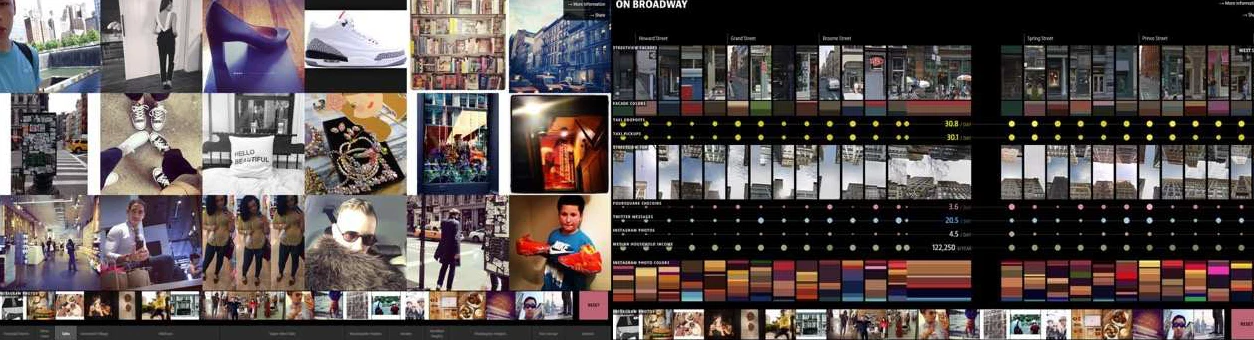
Header image: On Broadway: images shared in the SOHO area (left) and a screenshot from the application (right)
A) Creativity in Succession
The tensions inherent in the “expansion of the neoliberal economy” have become a global factor shaping many aspects of life in the 21st century. Increasingly, public policies encourage citizens to engage in entrepreneurial activities, including the management of public commons that were once centrally administered.
This does not change the fact that the competitiveness of economies and the well-being of communities depend on clearly defined goals. In Bulgaria, a member of the European Union since 2007, information and communication technologies (ICT) are among the driving sectors of the economy. In 2016, an explicit policy connection was finally being established between this rapidly growing economic sector and culture and the creative industries (CCI).
Yet we should ask: Can competitiveness and culture work together in a sustainable way? What relationships between policy, the arts and the digital age affect both local and global communities?
Recently, the role of information technologies in structuring production has changed significantly, while new models of consumption, such as the sharing economy, have emerged.
There are, of course, different understandings of what “sharing” means. Some of the clearest examples are disruptive digital innovations that would have been difficult to imagine several decades ago. These innovations challenge the value chains of traditionally established sectors and services by offering basic value propositions based on content sharing (e.g. Facebook) or resource sharing (e.g. Airbnb and Europeana). Such providers mediate the creation of services by engaging users as co-investors or semi-entrepreneurs.
But how accountable are these providers to the public, and which communities benefit from the enormous profits generated by some digital service providers?
Several decades ago, businesses aspired to build global empires. Since the emergence of the networked society (Castells, 2005: 351), they have increasingly relied on principles of horizontal integration. The emergence of peer production is associated with the freedom to operate through “commons-based production”, as demonstrated by Wikipedia and other Wikimedia projects.
Particularly in the fields of information, knowledge and culture, commons can be understood as open resources accessible to an undefined set of users. They rely on diverse and often unstructured motivational models and on rules of engagement that, in the public domain, may eventually amount to “anything goes” (Benkler, 2011).
Commons entail a moderately closed group of actors who rely on the commons or contribute to it, but organize themselves through relatively interdependent institutions, neither state nor market based.
Indeed, sharing “images” and “stories” is one thing; sharing success, profit or hardship is another. Yet all of these are communal practices, and digital technologies provide new ways of understanding how they are interconnected.
Big-data analysis can help track key dimensions of “sharing”, as demonstrated by the interactive installation On Broadway by Daniel Goddemeyer, Moritz Stefaner, Dominikus Baur and Lev Manovich. The project correlates sets of images and data collected from smart devices with statistics covering the 13 miles of Broadway that cross Manhattan.
The result validates the existence of an “invisible” divide between inclusion and exclusion in sharing practices.
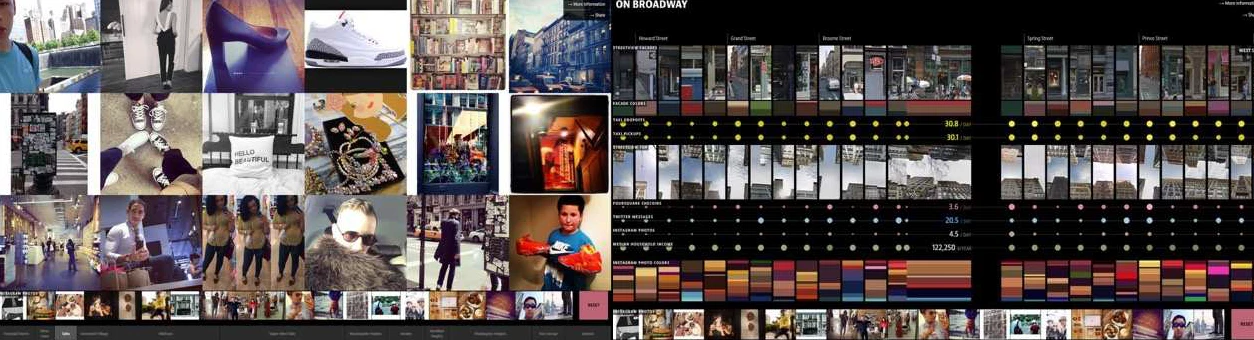
On Broadway: images shared in the SOHO area (left) and a screenshot from the application (right).
The project incorporates 660,000 Instagram photographs shared along Broadway over six months in 2014, Twitter posts containing images, Foursquare check-ins since 2009, Google Street View images, 22 million taxi pick-ups and drop-offs recorded in 2013, economic indicators from the US Census Bureau (2013), and users’ median income. The latter was approximately $135,187 among users in the Financial District and $28,323 in Harlem.
This big-data analysis provides commercial companies with insights into the interests and engagement patterns of thousands of people participating in the so-called sharing economy of ideas and creativity. At the same time, it demonstrates that thousands of people in the digital domain make much less use of “public” exchange.
This seemingly simple visualisation reveals boundaries and differences along a single street in a densely populated urban area. It exposes a considerable degree of diversity within a shared physical and digital environment.
We can imagine comparing digital participation among the inhabitants of Manhattan with that of people living in agricultural areas, who may nevertheless engage with global realities in very different ways. The profiles of users, the content of their images and messages, the intensity of their interactions with other people and services, and their lifestyles are likely to differ.
Yet the digital shift and the resulting inter- and intragenerational divides cannot be attributed exclusively to individual choices or initiative.
An application developed specifically to connect users and service providers within a territorial cultural economy based on “art miles” was Artory. As Alan Williams explains, “The real-time data analytics provided by user feedback gives the venues vital information about their audiences that can inform and secure investment for future projects and events.”
This is a good example of how ICT can be used to empower cultural analysis and, ultimately, serve the long-term interests of users—provided that they are among those participating in the digital sharing of culture.
A Finnish colleague once suggested that there was some truth in the fictional marketing slogan: “Nokia connects people and divides families.” The attraction of users and audiences can have an additional value: it provides insight into their behaviour through virtual data.
The challenge is therefore to establish clear goals that help societies retain cultural capital, define the public purpose of shared resources and make meaningful use of technology.
B) Public–Private Negotiations of “Success”
As illustrated above, immersion in digital technologies creates significant opportunities to connect like-minded individuals across particular lifestyles, communities and geographical boundaries.
However, policy-making that develops from the bottom up would quickly discover that competitiveness and the rapid emergence of horizontal networks based on inclusion and creativity are interdependent.
The 2015 Global Creativity Index, developed by the Martin Prosperity Institute in Toronto and structured around the “3Ts”, ranked 139 nations according to three pillars of development:
-
Technology: investment in research and development and patents per capita;
-
Talent: the share of adults with higher education and the proportion of the workforce belonging to the creative class;
-
Tolerance: the treatment of immigrants, racial and ethnic minorities, gays and lesbians.
According to the analysts, creativity is increasingly a cornerstone of innovation and economic progress around the world.
Yet behind these indexes are people, artists and communities concerned with the values of tolerance, freedom and sustainable economies.
In 2016, the UNESCO research report Cultural Times alerted policymakers and artistic communities to the dramatic changes taking place globally. These changes will affect the relationship between the right of ordinary people to access culture and their right to participate in shaping culture anywhere in the world.
A study commissioned by the International Confederation of Societies of Authors and Composers reinforces the argument that cultural and creative industries contribute significantly to sustainable development. However, an important concern remains: these industries are growing at the expense of numerous artists who remain disadvantaged by the arts market.
Is a nation or city competitive because it attracts highly skilled CCI workers and affluent tourists?
Not necessarily. Prosperity can also emerge from the ability to recreate cultural industries while avoiding elitism in new avant-garde facilities. As Miguel Rivas argues in the Key Messages of the URBACT Network on Creative Clusters, cities should test new formats for promoting and managing creative facilities while empowering creative strategies rooted in local contexts and potential.
A further survey of cities considered living laboratories for culture in Asia and Europe indicates that temporary cultural facilities hosting arts initiatives can have a lasting impact on the development of inclusion policies (Mangano & Sekhar, 2015).
The support of public authorities and private actors for activities that develop talent and transform urban space is therefore an essential prerequisite.
A whole chapter of this discussion concerns the European Capitals of Culture. In 2019, the European Capital of Culture will be Matera, Italy, together with its twin city, Plovdiv, Bulgaria, under the motto “TOGETHER”.
When cultural policy dissolves
What happens when cultural policies dissolve into thin air? Is this simply a consequence of inefficiency in market terms?
Many political leaders in “transition” economies argue that it is impossible to maintain the cultural infrastructure of the past. Even in capital cities, cultural infrastructure was sometimes artificially expanded through state intervention, while the creative class did not necessarily emerge from market demand.
Yet cultural production is not simply a by-product of consumer interest.
The history of Nokia provides an instructive example. It reminds us that the term “success” may be designed by politicians, but it is ultimately defined by people.
The Nokia company and the City of Helsinki negotiated an agreement that would allow the city to acquire the valuable, vacant site of the Kaapelitehdas (Cable Factory) from Nokia's industrial heritage and repurpose it for public benefit.
During the negotiations, artists and companies began renting the unused and deteriorating industrial infrastructure. When faced with the company's restructuring plans, they established the Pro Kaapeli association and developed an alternative plan to preserve the building and the activities taking place there.
According to the official Cable Factory website, Pro Kaapeli attracted national media attention and helped challenge deeply rooted prejudices against squatters and artists, who were often viewed as marginal or suspicious groups.
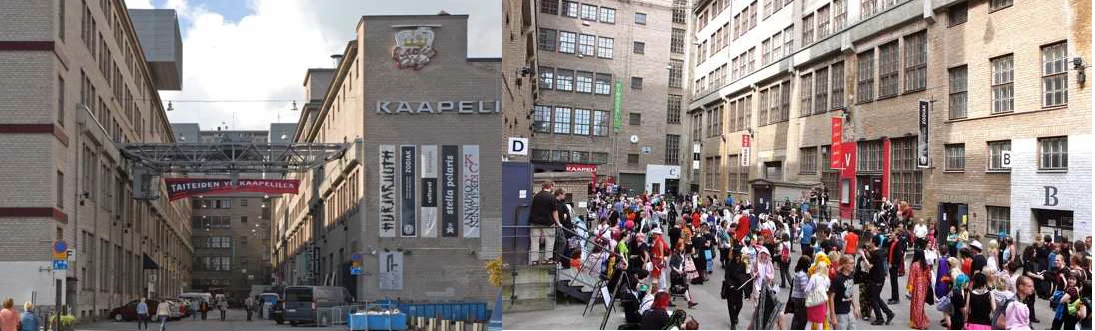
The façade of the Cable Factory today (left, © Jean-Pierre Dalbéra/Flickr) and visitors to Finncon 2009 (right, © kallu/Flickr).
Pro Kaapeli also identified deficiencies in the area's planning and brought them to public attention through the media.
The Cable Factory was ultimately allowed to remain in its original form. A new agreement was reached with Nokia, the city council decided to protect the building and its surroundings, and an estate company was established. Almost all existing tenants were allowed to remain.
Today, the Cable Factory is a flagship cultural enterprise in Europe. It houses three museums, thirteen galleries, dance theatres and art schools, as well as facilities for visual artists, bands and companies. It hosts concerts, exhibitions, festivals and fairs.
The reconstruction project of the public estate company Kiinteistö Oy Kaapelitalo began in 1991 and recovered its investment in fewer years than initially expected (Koleva, 2013). Its turnover reached €3.5 million in 2005 and more than €5 million in 2012.
Nevertheless, the viability of the investment was questioned whenever newly elected city officials came to power. As former Economic Director Nikula Stuba explained, the underlying issue was rather simple: public officials are among those who assume the right to define “public interest” (Sorbello & Weitzel, 2008).
Culture and gentrification
Around the world, corporate investment in large-scale construction projects has been documented as a driver of gentrification and community disruption.
Artists often play a central role in transforming a neglected neighbourhood or industrial infrastructure into a creative space. Inevitably, the resulting “art hype” attracts audiences, often particularly younger ones. The popularity of the area then increases property values.
Eventually, however, economic restructuring can lead to the displacement of artists, local residents and small businesses.
A case study from Barcelona illustrates this process. The redevelopment of a former factory deliberately attracted artists as part of an effort to transform the area (Casellas, Dot-Jutgla & Pallares-Barbera, 2012: 104–114). Artists and local residents attempted to resist the plan, but their efforts were not entirely successful.
A similar question emerged in Sofia, where plans to transform a former industrial area into an arts quarter involved attempts to attract artists to privately owned property and encourage the municipality to consider strategic investment in the area.
For the moment, poor infrastructure has stalled the plan.
This example raises a fundamental question:
Who makes decisions on behalf of the public when those decisions involve public investment in culture?
In Bulgaria's post-transition economy, a cultural zoning plan might have required public investment to acquire sites and buildings that had previously been privatised through often non-transparent post-socialist transactions.
Based on personal interviews with independent artists, cultural managers and the Sofia Development Association in December 2015.
Sofia: “Shared Vision”
The autumn of 2016 marked a significant moment in Sofia's recent history. I became involved in the design of a participatory policy process that had emerged while this article was being developed.
For the first time, the city authorities were supporting a dialogue with non-state actors around a common goal: strengthening the potential of Sofia's growing independent contemporary arts scene.
“Shared Vision” was the name given to a cultural strategy designed to foster the development of dance, literature, music, visual arts and theatre.
Immediate results were expected by 2019, when Bulgaria would assume the Presidency of the Council of the European Union. By that time, two purposefully refurbished municipal sites were expected to open as centres operated in partnership with the independent contemporary arts sector.
By 2023, support for independent initiatives by organisations, artists, formal and informal associations was intended to transform Sofia into an attractive environment for co-creation, public interaction and professional development in the arts.
The future, it was hoped, would become more certain.
C) “Success” Designed by Creative Ecosystems
Across Europe and globally, cultural centres that originated as civil-society initiatives are facing serious challenges. Their business models need to evolve in response to the need to reconnect with the public.
Trans Europe Halles, a network of independent cultural centres, identifies three common characteristics among successful organisations, including Kiinteistö Oy Kaapelitalo. Sustainable cultural businesses tend to:
-
Mix and merge new and traditional types of services, offering diverse art forms alongside recreational activities;
-
Rent out spaces to other organisations;
-
Engage volunteers and freelancers in organising multiple events throughout the year.
These indicators suggest that cultural operators and artists conduct considerably more “business” than is often recognised. They create substantial value, but do not always receive adequate compensation for it (Schiuma, Bogen & Lerro, 2015).
This highlights the importance of improving business models in order to survive within increasingly complex structures of competition and cooperation.
A hybrid model is emerging in Bulgaria, Ukraine, Finland and Germany—in geographically distant but structurally comparable contexts.
Cultural organisations should not become the “dupes” of neoliberalism, working indefinitely for the “public good” without sustainable resources. Cultural capital is difficult to measure because much of its value is symbolic, but it is also difficult to accumulate because skilled managers frequently leave a sector characterised by low pay.
Performance measurement is still rarely implemented in the European public sector. Without evidence-based cultural policy incentives, there is little reason to expect this situation to change; budget cuts are easier to justify when the impact of cultural activity cannot be demonstrated.
Yet this could change if the digital shift enables the measurement of the impact of externalities. Such measurement could strengthen cooperation among networked entrepreneurs.
Behind this transformation, however, there must be political will.
Despite the philanthropic efforts of individuals, certain public goods—such as affordable and accessible arts—derive from people's right to participate in a shared economy of values. One of those rights is the right to participate in designing state intervention.
At the beginning of the 21st century, cultural organisations are increasingly recognised as major contributors to social welfare and producers of intangible cultural capital. There have always been explicit as well as implicit policies that shape or undermine their success (Koleva & Cherrington, 2010).
In 2015, following the terrorist attacks in Paris, Italy's Prime Minister Matteo Renzi pledged €1 billion for culture and security. The Bardo Museum in Tunis, the site of the March attacks, announced a cultural partnership with the Museo di Arte Orientale in Turin in an effort to contribute to peace and stability in the region.
Such examples demonstrate that culture can be understood not merely as an economic sector but also as a component of social resilience and public policy.
Shared infrastructure and hybrid governance
Some policies concern the governance of public space; others concern the distribution of wealth for public purposes.
There is an intricate relationship between public ownership and not-for-profit business models, but this is not necessarily the only option.
Increasingly, privately owned, for-profit creative businesses operate co-working spaces. By contrast, it remains uncommon for micro non-profit arts organisations to manage cultural infrastructure jointly with a for-profit legal entity.
The success of the Cable Factory lies not only in its economic performance as a self-sustaining cultural space, but also in its innovative business model.
The estate company owns the infrastructure, allowing it to plan for the future over a long time horizon. This creates a micro-systemic context that differs fundamentally from the position of individual cultural organisations dependent on constantly changing public funding lines.
An efficient governing structure mirrors the ecosystem's participatory principle.
The Board of the Cable Factory has eight members: representatives of the two main political parties, two members from city departments, three tenants and an independent outsider serving as chair.
Arts and culture coexist within a democratic shared space in which tenants pay rental charges adjusted to their capacity to generate turnover.
The range extends from symbolic rents for artists' studios and cultural micro-enterprises to higher rents for CCI companies, such as multimedia content producers.
This creates a sustainable ecosystem across the spectrum of knowledge-intensive cultural and creative industries.
Typically, the time invested in developing talent and creating a new artwork cannot be measured against the profit generated by its first public presentation.
An original piece of music, a drawing, choreography or script becomes a “product” that may eventually attract multiple viewers, listeners or live audiences. Yet it is often intermediaries, rather than artists themselves, who reap the greatest economic benefits.
A shared-risk governance model is therefore particularly relevant to the 21st century. The open-innovation potential of creative cohabitation can be redistributed towards sustaining talent.
This makes it possible for a wide range of high-quality products and services—some free of charge, others commercially priced—to originate within the same ecosystem.
Hybrid development and the cultural cluster
The hybrid for-profit/not-for-profit, participant-based development model has a multiplier effect.
Kiinteistö Oy Kaapelitalo has championed a similar transformation in a former electrical power plant and now also administers the premises in Suvilahti.
As Kuusimäki (2015) explains, the policy is to develop the area as a cultural cluster “piece by piece, little by little”. There was no opening ceremony for Suvilahti and there will not be one: the area remains in a constant process of change and development.
The example emerged from a student summer school researching New Urban Hybrids as a global trend in 2015.
There are therefore many reasons why inclusive cultural policies should consider cultural infrastructure and its impact on arts management—and why digital access to policy participation and impact assessment should be integrated into such policies.
D) Arts Managers: Demand and Participation
Globally, creators and owners are often separated early in the process by market mechanisms. Similarly, people who access digital offers may be disconnected from those who have the means, knowledge or opportunity to participate in policy creation.
The Viva Cultura Comunitária policy in Brazil is notable because it emerged from a new type of civil-society movement.
Arts and culture activists sought to draw attention to policies supporting live arts and cultural forms of expression within communities across Latin America.
After a decade of participatory processes—including gatherings, public manifestations and the development of proposals—the movement succeeded in influencing cultural policy.
In 2014, Brazil passed legislation allocating 0.1% of the federal budget to live culture. For many post-socialist European countries, the entire public budget for culture—including arts, heritage protection, visual arts and libraries—is approximately this percentage.
Another significant feature of the Brazilian model is that it is “fostered” rather than “governed” by the state.
Several layers of decentralisation structure priorities and the distribution of funds. The system recognises initiatives of any entity that develops or facilitates cultural activities within a community.
With a plan to expand the network of Pontos de Cultura to 50,000 by 2020, the policy introduced a system in which proposals could even be submitted by video. This helped ensure that language and literacy barriers would not prevent communities from expressing their cultural needs and initiatives.
Technology is thus used to mediate inclusive cultural policy while supporting cultural activity originating locally, including outside major urban centres.
In 2016, the European Commission launched a special action within the Horizon 2020 programme to “boost synergies between artists, creative people and technologists.”
This represented a step in the right direction, encouraging artists and CCI managers to explore hybrid partnerships.
The challenge for the future is to enter participatory research and management processes before creative processes become driven by predetermined business visions and profit expectations based on “market-ready” prototypes.
The changing role of arts managers
There are clearly powerful ways to innovate cultural services and products, particularly by engaging people in active policymaking and creative-economy models.
I would like to thank Mary McBride, Chair of the Graduate Design Management and Arts & Cultural Management programmes at Pratt Institute, for encouraging me to put some of these ideas into writing.
Our informal global professional networking brought us together in the summer of 2015 for a discussion about the growing recognition of new skills required to manage transformation and benefit from emerging forms of engagement in arts and cultural projects around the world.
The know-how of arts managers is increasingly shifting towards creating insider experiences with experimental forms of policymaking and collaboration.
This involves working not only with authorities and citizens, but also with other arts organisations, ICT partners, virtual communities, researchers and emerging specialists in digital data analysis.
This article has not addressed several important areas, including hybrid models for managing artists' rights, the relationship between virtual and physical performance venues and markets, or arts management based on user-demand co-financing—areas that other colleagues have begun to explore.
I hope that these four sections have encouraged arts managers to recognise the need to work together in concerted efforts towards policies that support professional development programmes at international level and across the divides between profit and non-profit, virtual and live, and large and small organisations.
The challenge is not simply to adapt cultural management to digital transformation, but to ensure that digital transformation contributes to more inclusive cultural participation, stronger creative ecosystems and more democratic cultural policymaking.
Recommended Literature
-
Benkler, Y. (2009). “Peer Production and Cooperation.” In J. M. Bauer & M. Latzer (eds.), Handbook on the Economics of the Internet. Cheltenham and Northampton: Edward Elgar.
-
Benkler, Y. (2011). “Between Spanish Huertas and the Open Road: A Tale of Two Commons?” Presentation at the Convening Cultural Commons Conference, New York University, September 23–24, 2011.
-
Casellas, A., Dot-Jutgla, E. & Pallares-Barbera, M. (2012). “Artists, Cultural Gentrification and Public Policy.” Urbani Izziv / Urban Challenge, 23(1), pp. 104–114.
-
Castells, M. & Cardoso, G. (eds.) (2005). The Network Society: From Knowledge to Policy. Washington, DC: Johns Hopkins Center for Transatlantic Relations.
-
Koleva, P. & Cherrington, R. (2010). Implicit Cultural Policy – The Role of Social Clubs in Communities – Intercultural Training Module for Culture Operators. Tagete, Pontedera.
-
Koleva, P. (2013). Innovation Projects as a Strategic Development Factor for Cultural Organisations. Sofia: Orgon / Intercultura Consult, 01/2013.
-
Kuusimäki, A. (2015). “Urban Transformation through Culture. Regenerating the Old Electricity Production Facility of Suvilahti in Helsinki.” In J. Lilius (ed.), New Urban Hybrids: Re-setting Borders, Combining Scales. Aalto University Publication Series CROSSOVER 1/2015.
-
Mangano, S. & Sekhar, A. (2015). Cities: Living Labs for Culture? Case Studies from Asia and Europe. Singapore: Asia-Europe Foundation (ASEF).
-
Schiuma, G., Bogen, P. & Lerro, A. (2015). Creative Business Models: Insights into the Business Models of Cultural Centers in Trans Europe Halles.
-
Sorbello, M. & Weitzel, A. (eds.) (2008). Cairoscape – Images, Imagination and Imaginary of a Contemporary Mega City.